
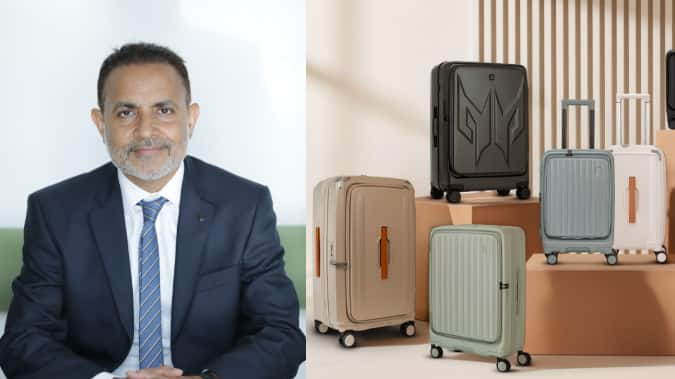
For decades, Acer has been shorthand for laptops, desktops and consumer electronics. In India, however, the company is now attempting something more layered: asking consumers to see it beyond computing. Its latest move into travel accessories is less about selling suitcases and more about testing whether a legacy technology brand can build relevance in lifestyle categories without looking like it is simply chasing adjacencies.
In a conversation with FE Brandwagon Online around its latest India launch, Acer executives framed the new luggage portfolio as an extension of changing consumer behaviour rather than a standalone diversification bet. The company has introduced a new range of travel-ready luggage across series such as Melbourne, Melbourne Plus, Barcelona, Copenhagen, Brisbane and the premium Predator line, targeting everyone from business travellers to long-haul holidaymakers.
The bigger question, however, is whether consumers will buy the logic.
Can a PC brand earn trust in travel?
India’s luggage market is hardly short of players. From established names with decades of recall to D2C brands selling design-first travel gear, the space is crowded and price-sensitive. For Acer, entering that market means confronting a perception gap: why should a consumer trust a company known for laptops with their luggage?
Alok Dubey, CFO, Acer India, argues that the move is less of a pivot and more of a continuation.
“Acer has always been a technology-first brand, but at its core, our strength lies in understanding evolving consumer lifestyles and building products around those needs,” he said. “Our entry into travel gear is a natural extension of that philosophy, not a departure from it. As consumers increasingly seek connected, design-led experiences, travel becomes a relevant extension of that ecosystem.”
That framing matters because Acer is not positioning itself as another luggage label. It is trying to occupy a narrower space where utility, mobility and technology overlap.
Designing around utility, not aspiration alone
The products themselves reflect that strategy. The Barcelona series, for instance, comes with a front-opening design aimed at quick access in airport lounges and hotel rooms, along with a dedicated laptop protection layer. The Copenhagen and Brisbane ranges use dual-opening systems for faster access during transit, while the Melbourne line focuses on lightweight polycarbonate builds with TSA-approved locks and reinforced corners. The Predator series sits at the premium end with a reinforced frame structure aimed at frequent travellers.
These are practical differentiators, but in a category where visual identity often drives first purchase, functionality alone may not be enough.
Dubey acknowledges that recall will depend as much on storytelling as on specifications.
“The travel gear market in India is competitive, but we see that as an opportunity to bring a differentiated perspective,” he said. “Acer’s approach is not to compete as just another luggage brand, but to carve a distinct space at the intersection of technology, functionality, and modern travel needs.”
That distinction is subtle but important. Rather than competing on colour palettes or celebrity campaigns, Acer is trying to anchor the proposition around intelligent design and problem-solving.
The harder task is changing perception
For many legacy brands, category expansion is not about product creation but about consumer permission. People may understand that a tech company can make luggage, but that does not mean they instinctively want it to.
Acer’s answer is to avoid over-explaining and instead lean into what already feels credible.
“We are leveraging Acer’s strengths, innovation, smart functionality, reliability, and thoughtful design to bring differentiated value to the travel category,” Dubey said. “Products like premium luggage and tech-enabled accessories allow us to enter a space where our technology heritage is a clear advantage.”
He adds that branding will have to do the heavier lifting.
“Beyond product features, the focus will be on communicating how Acer enhances the travel experience through smart, design-led solutions rooted in our technology DNA. We see storytelling as a way to connect Acer’s legacy of innovation with evolving consumer lifestyles.”
This is where the real brand test lies. Consumers do not remember feature lists, they remember associations.
Beyond devices, towards a lifestyle ecosystem
Harish Kohli, President and Managing Director, Acer India Group, places the move within a broader diversification strategy.
“Travel today has become more dynamic, connected, and experience-led, and consumers increasingly seek products that combine utility, durability, and intelligent design,” he said. “Our entry into the travel accessories segment reflects a natural extension of Acer’s brand philosophy, bringing purposeful innovation beyond traditional technology categories into lifestyle-led ecosystems.”
There is also a sustainability layer to the pitch. Some of the products use recycled polyester (rPET), made from post-consumer recycled plastics, reflecting Acer’s wider manufacturing commitments.
Available through Flipkart and Acer’s online store, with prices starting at ₹5,999, the range is clearly aimed at India’s growing cohort of young professionals and frequent travellers.
But the real metric will not be units sold in the first quarter. It will be whether consumers begin to think of Acer as something more than a PC brand.
“Ultimately, building relevance beyond computing requires demonstrating that Acer understands modern consumer aspirations holistically,” Dubey said. “Through product innovation and strategic storytelling, we want consumers to see Acer not just as a PC brand, but as a broader lifestyle technology brand.”
That ambition is far harder to pack than a suitcase.