
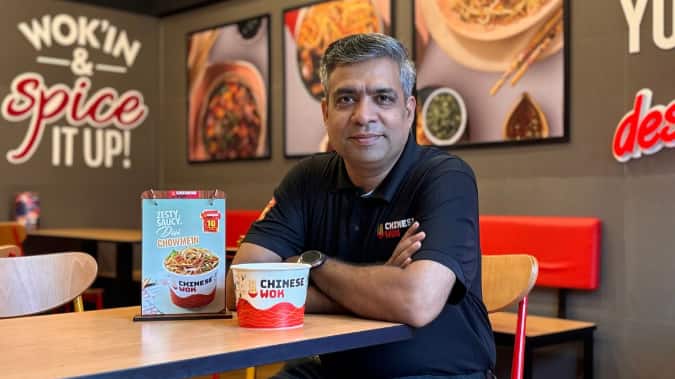
Lenexis Foodworks is not chasing scale for the sake of scale. As the parent company behind Chinese Wok, Big Bowl and The Momo Co., the company is building what Vikas Iyer, Head of Marketing at Lenexis Foodworks, calls a “focused house of brands” rather than simply adding more restaurants. In a conversation with FE Brandwagon Online, Iyer outlined how the company is shaping category-first brands, deepening cultural relevance, and using marketing not just to sell food, but to create habits.
With Chinese Wok crossing Rs 500 crore ARR in FY25 and targeting the Rs 1,000 crore milestone, the larger ambition is clear: make Desi Chinese a branded category in India, not just a cuisine people order on impulse. “We would want Chinese Wok to become synonymous with the Desi Chinese category,” says Iyer. “Ultimately, in the next 10 years, what we would want to do is create occasions so that people choose us habitually, and not choose us just for indulgence once in a while.”
Also Read: HoABL is trying to do what India never did with land: turn it into a brand
Building categories, not just outlets
Chinese Wok, which completed a decade this year, remains the flagship and category-defining brand in the portfolio. With over 260 outlets and a target of 500 stores by mid-2028, it is being positioned as the go-to destination for Desi Chinese cravings.
But for Lenexis, the playbook extends beyond one successful brand.
“Chinese Wok is positioned as a category-defining brand in the Desi Chinese segment,” says Iyer. “With Big Bowl, we are shaping the bowl-led format. The Momo Co. is a specialist play where we experiment, innovate and sharpen products in the growing momo category.”
Big Bowl, already a Rs 100 crore-plus cloud kitchen business with over 250 kitchens across 14+ states, is built around convenience and fulfilment, while The Momo Co. functions as a sharper innovation lab in the fast-growing momo category.
The idea, according to Iyer, is long-term leadership across categories, backed by one scalable operating backbone. “We are conscious about building a focused house of brands and not just increasing the number of restaurants,” he says.
Why Tier II and Tier III cities are the real growth lever
While metros remain important, the next phase of growth is being powered by smaller cities.
“In fact, Tier II and Tier III cities have been a big growth lever for us,” says Iyer. “In these cities, we become the first player in many cases to enter the market with a Chinese cuisine offering or a bowl-led offering. Therefore, there is a lot of traction, a lot of brand love that comes our way in the initial days.”
The company follows a complete COCO (company-owned, company-operated) model across all stores, allowing tighter control over consistency, quality, and representation. But localisation is not being treated as discounting.
Instead, Lenexis focuses on what Iyer calls “occasion-led value offerings.”
“Whether it’s local festivals, local events, or national moments like a match, we ensure that we position ourselves as a go-to place for shared moments,” he explains. “While we are localising the voice, we are making sure that we have a consistent national brand impact.”
Language-first storytelling also plays a major role. Regional communication is tailored to help the brands become part of everyday life in local catchments without diluting the national identity.
When storytelling comes before selling
If there is one marketing shift Iyer strongly believes defines modern QSR growth, it is this: storytelling now comes before selling.
“Historically, we would have said come and buy from Chinese Wok and given it a very logical spin,” he says. “But now I’m building a narrative around the whole piece and building it in an integrated fashion across touchpoints so that consumers get a perspective across different areas they interact with us.”
This thinking shaped campaigns like Chinese Bole Toh Chinese Wok, launched during the brand’s 10-year milestone, and Wok FM, a proprietary music platform that turned the brand into one of the first QSR players in India to use owned music as an in-store and digital engagement lever.
Rather than positioning offers as transactional discounts, the team builds cultural hooks around them. A recent example was “Crush Hour” during Valentine’s season.
“We offered a buy one, get one, but called it Crush Hour with Wok,” says Iyer. “Buy one, get one was by the way, but the narrative is what consumers resonated with.”
This culture-first lens is also driving platform decisions. On Instagram, content is judged not by reach alone, but by whether it gets shared or saved.
“We ask for each content that we create whether it is shareable, whether it gets saved or not. And that’s improving engagement rates and we’re seeing more traction.”
Also Read: Balaji Telefilms 2.0: Scaling Micro-Dramas, YouTube and Talent Management
Desi Chinese, but sharper
Menu innovation is another core pillar, and the brief is simple: familiar food, but with sharper relevance.
An internationally loved product with a Desi Chinese spin is already lined up for launch. Earlier experiments like crunchy momos and chowmein-inspired flavour innovations have helped validate the approach.
“Manchurian across the country is served just in one single sauce,” says Iyer. “But we said, why not try it out in all the other sauces that people are loving so much? We launched it in six different sauces and it’s been a huge hit for us.”
Big Bowl is taking a similar route by bringing in regional dishes and comfort-led innovation that feels familiar to audiences in southern and eastern India.
The aim is not novelty for novelty’s sake, but incremental business through repeatable product wins.
The 500-store milestone, and what comes after
Lenexis is currently adding 80 to 100 stores annually, with the first major milestone set at 500 stores by mid-2028.
But Iyer believes the real moat will not come from store count alone.
“The brand building that we’re doing is the strongest and the most long-term lever that I see,” he says. “We are not basing our marketing only on short-term bursts as campaigns, but building long-term repeatable assets that will define us.”
That means stronger cultural IPs, sharper category ownership, and building brands that feel native to consumers rather than simply visible to them.
For a homegrown QSR company competing in one of India’s most crowded categories, the ambition is straightforward: not just to be ordered, but to be remembered first.