
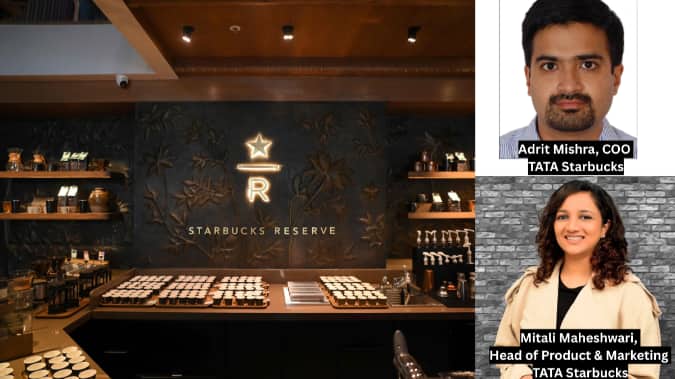
India’s first Starbucks store in New Delhi, housed at Hamilton House, now returns as a Starbucks Reserve. The shift is not simply about introducing another premium format. It reflects a response to a consumer who is beginning to treat coffee as something to be explored, not just ordered. The choice of location adds its own layer. By bringing the Reserve experience to this address, Starbucks ties the future of the category to its earliest footprint in the city.
As urban coffee drinkers move past familiarity and convenience, showing greater interest in origin, brewing techniques and flavour profiles, the role of the café itself is changing. In a conversation with FE Brandwagon Online, Adrit Mishra, COO, TATA Starbucks, and Mitali Maheshwari, Head of Product and Marketing, TATA Starbucks, describe this reopening as a marker of that shift. Café spaces today are as much about time spent, interaction and identity as they are about the beverage. The Reserve format brings these threads together, positioning the store not just as a place to get coffee, but as a space to understand it better.
From serving coffee to staging it
What the Reserve format attempts is a subtle repositioning. It takes coffee out of the realm of routine and places it closer to experience. At the Hamilton House store, this plays out through the Reserve Bar, brewing rituals, and equipment designed for precision rather than speed.
“Starbucks Reserve represents an elevated, craft-led format where customers can explore small-lot coffees, experience different brewing methods and engage more deeply with our Coffee Masters,” says Adrit Mishra, COO, TATA Starbucks.
This push towards immersion is not happening in isolation. It mirrors how consumers are beginning to engage with the category itself.
“There is growing curiosity around origin, brewing methods and flavour profiles, along with a willingness to spend more time with the experience,” Mishra adds.
That same shift is visible from a marketing lens as well, where the act of choosing coffee is becoming more expressive.
“What customers choose to drink and engage with becomes a reflection of identity,” says Mitali Maheshwari, Head of Product and Marketing, TATA Starbucks.
The India question, still being answered
For Starbucks, India has always demanded a balance between sameness and specificity. The Reserve store at Hamilton House reflects that tension rather than resolving it.
On one hand, the fundamentals remain intact. The brand continues to anchor itself in high-quality Arabica, standardised processes and global brewing techniques.
On the other, the interpretation is increasingly local. The design language draws from Indian materials and craft traditions. The menu carries beverages that borrow from familiar flavours. Even the way the space is experienced is calibrated to how Indian consumers use cafés.
“Localisation comes through in how we interpret flavours, beverages and the overall experience,” Mishra says, pointing to products such as Tamarind Shikanji Cold Brew and Malabar Coconut Cold Brew.
For Maheshwari, this extends beyond what is served to how the brand embeds itself in everyday culture.
“Relevance is built across multiple touchpoints, from beverages and food to in-store experiences and merchandise,” she says.
The approach is less about overt localisation and more about familiarity. It is designed to make experimentation feel less foreign.
A category getting crowded, and more nuanced
The premium café segment in India is no longer sparse. New entrants, independent cafés and global chains are all competing for the same consumer. Yet Starbucks appears to be betting that the category’s growth works in its favour.
“The category is becoming more competitive, and we see that as a positive indicator of its growth and relevance,” Mishra says.
The response is not to outpace competitors on expansion alone, but to build a more defensible experience layer. Coffee quality, store environment and partner training remain central, but there is a visible attempt to widen the ecosystem.
This includes working with over 100,000 farmers through its Farmer Support Partnership, strengthening sourcing capabilities while reinforcing its positioning around coffee craft.
At the same time, the brand is nudging behaviour rather than waiting for it to evolve.
“Through formats like Starbucks Reserve, we are creating spaces where customers can engage more deeply with coffee and make it part of their everyday routines,” Mishra notes.
Experience, data and the everyday customer
While the Reserve format speaks to depth, the broader business continues to be shaped by convenience. The challenge lies in reconciling the two.
Starbucks is building a connected ecosystem that allows it to operate across both ends of the spectrum. The in-store experience is complemented by a digital layer that tracks behaviour and enables personalisation.
“At the core is our Starbucks Rewards program, which enables us to tailor offers, benefits and experiences based on customer engagement and preferences,” Maheshwari explains.
This extends to mobile ordering, delivery partnerships and WhatsApp-based interactions, all designed to reduce friction without diluting brand recall.
The interplay between experience and convenience is also visible in how formats are being rethought. From neighbourhood cafés to airport stores and drive-throughs, each is designed around a specific use case, while still feeding into a consistent brand experience.
Café culture as identity
If there is one thread that runs through both product and marketing, it is the recognition that café culture in India is changing shape.
“Younger consumers are making café culture more expressive, social and identity-driven,” Maheshwari says.
This has implications beyond menu innovation. It affects how stores are designed, how products are launched and how stories are told.
Initiatives such as Cold Brew Week, with in-store tastings, are less about pushing a product and more about building participation. Merchandise collaborations with designers and global brands further extend the experience beyond the cup.
For Starbucks, storytelling now sits closer to lived experience than advertising.
“It is built around real consumer moments, reflecting how people engage with Starbucks in their daily routine,” Maheshwari notes.
A slower, longer play
The Hamilton House Reserve store may draw attention because of its format and location, but it is also a signal of how Starbucks is approaching India.
There is scale, but there is also restraint. Expansion continues, guided by demand and catchment potential, but formats like Reserve suggest a willingness to invest in depth even as the network grows.
“India is a long-term market for us, we will remain focused on creating a differentiated and elevated coffee-first experience,” Mishra says.
The implication is clear. As the category matures, the battleground may shift from availability to engagement. Hamilton House, in that sense, is not just a flagship. It is a marker of where the conversation around coffee in India is headed.