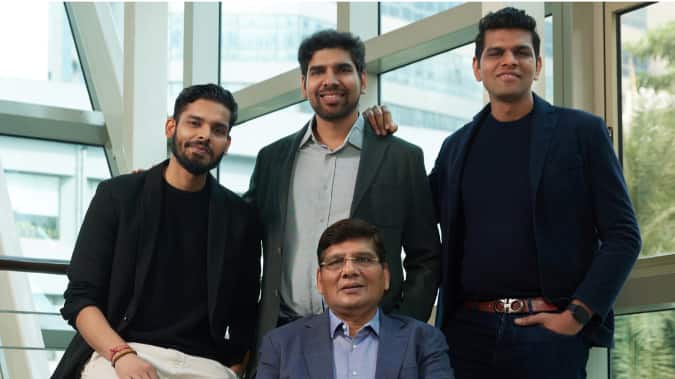
In a category long dominated by legacy neighbourhood stores on one end and rarefied designer ateliers on the other, KALKI built its proposition in the gap. In a conversation with FE BrandWagon Online, founders Saurabh Gupta and Nishit Gupta spoke about identifying that whitespace early, and about turning it into a structured, scalable business model.
Founded in 2007 by second-generation entrepreneurs Saurabh, Shishir and Nishit Gupta, the Mumbai-based brand entered a market that was emotionally rich but structurally fragmented. Weddings were aspirational, but the buying experience was either intimidatingly premium or aggressively transactional. “Either there were designers who were extremely high-priced and a little intimidating, or there was the mass market where the experience was pushy and sales-oriented. There were no brands offering a great experience around buying ethnic wear. Wedding shopping is a once-in-a-lifetime moment. You want to feel excited and special,” says Saurabh Gupta.
That insight shaped KALKI’s founding idea. Accessible luxury was not framed only as a price point. It was about creating a space where design, service and aspiration could coexist without alienating the customer.
From a single studio in Mumbai, the brand has grown to 11 flagship stores across key metros, alongside a strong digital direct-to-consumer presence and an international footprint in the US, UK, Canada and Australia. Bridal today contributes roughly 35 percent of sales, while family and guest occasion wear brings in another 35 to 40 percent. The revenue mix reflects a deliberate shift from a bridal label to a broader wedding ecosystem.
Also Read: How Etihad Guest Is Building India’s Next-Generation Loyalty Play
Reimagining the Modern Wedding
For Nishit Gupta, the brand’s differentiation lies in cultural relevance as much as retail strategy.
“When we started, premiumisation was already happening. Indians were travelling more, studying abroad, being exposed to international brands. We believed in the youth of the country. We did not want a heritage-classical looking experience. We wanted something that represents modern weddings, which are about celebration with friends, cousins, parents and your partner,” says Nishit.
That positioning translated into stores that feel contemporary rather than traditional, collections that shift with themes such as destination and beach weddings, and marketing that captures the joy of the occasion.
“We are constantly evolving. We are not confined to a prototype of design philosophy. What we practice on a day-to-day basis is reflected in our collections. We address even the smaller problems of the customer. Today there are themed events, destination weddings, carnival concepts. We make sure we are relevant to those needs,” says Nishit.
Internally, the brand operates with a simple mandate. “Our motive is to make sure that the customer feels like a celebrity on their special occasion. Whatever they buy from KALKI should make them stand out,” he says.
Beyond the Bride
In a wedding economy that often revolves around the bride, KALKI’s model expands the lens.
“If you consider the entire lifecycle of a customer, the bride is active not only during her wedding. After that there is Karva Chauth, baby showers, siblings’ weddings, and family events. We do not want to stop at satisfying them with bridal. We want to continue with them in their lifecycle,” says Saurabh.
That approach is visible on the shop floor. Bridal trials frequently turn into styling sessions for parents, siblings and grooms. “When a bride finalises an outfit, we encourage the mother, father or groom to try something that complements her. That family picture is everything. That moment stays for life,” he says.
The numbers support the strategy. With close to 40 percent of sales coming from family and guests, the brand reduces dependence on a single high-ticket purchase and builds recurring engagement.
Personalisation forms the other pillar. “We do not completely change designs. But we personalise. Every person has a personality. It could be modern or classical. We are experts in adjusting the outfit to suit that personality,” Saurabh explains.
Also Read: Retail Expansion, Category Depth, Global Exploration to Power Suta’s Next Phase of Growth
Storytelling as Strategy
From a brand perspective, KALKI’s marketing playbook leans heavily on narrative.
“We rely a lot on storytelling. Even when we were re-strategising almost ten years ago, we recognised that we want to play on real emotions. Our campaigns have never been product-centric. They have always been customer-centric,”reiterates Nishit.
An early Raksha Bandhan campaign celebrated sisters protecting each other. “The objective was to create a conversation that if you do not have a brother, you do not have to stop celebrating. The sisters can protect each other. The brand just happened to be there.”
That emphasis on emotional storytelling feeds into community building, which Nishit describes as a long-term strategy. Performance marketing, by contrast, focuses on acquisition.
“Both are important and go hand in hand. Community building is long term and LTV driven. Performance marketing is crucial for new customer acquisition. Even in performance, we maintain storytelling at the top of the funnel and then move to product-led conversion. Customers must buy the brand first and then the product. We do not rely on deep discounting,” says Nishit.
The Celebrity Signal
A turning point came when the brand began working closely with celebrity stylists.
“When stylists and celebrities started wearing KALKI at award events and weddings, it created validation in the minds of customers. It helped position us strongly as a brand that offers innovative designs with credibility,” adds Nishit.
Showcases such as the Zeyhen collection at Falaknuma Palace helped frame the brand within a more global creative context.
Collaborations have been personality-led rather than opportunistic. A beach wedding edit with Alanna Panday leaned into youth and ease. A high-drama collection with Raja Kumari tapped into performance glamour. A forthcoming line with Rhea Kapoor is expected to reflect her understated luxury aesthetic.
“When we collaborate, we choose personalities for who they authentically are. That creates stronger authenticity in communication.”
Also Read: The Legacy Trap and the Relevance Test: Bata India’s Modernisation Story
Capital and Control
The Rs 225 crore investment from Lighthouse Funds marked a significant milestone for the company.
“When you are bootstrapped, you are focused on the immediate next step. With this backing, we can think long term. We are investing in people, processes and technology. Governance and systems increase the organisation’s lifetime,” Saurabh says.
Over the last three years, the company has grown at roughly 45 to 50 percent annually. With new stores opening across the country, the expansion strategy remains measured.
“We own 95 percent of our experiences directly. Our stores are company-owned. Online, in India and internationally, we operate D2C. We do not rely on marketplaces. Owning the experience ensures consistency and trust.”
That consistency, he argues, is central to brand equity in a price-sensitive market. “We are not a brand that goes on multiple discounts in a year. Brand is defined by consistency and trust.”
Listening as Discipline
Despite access to global trend forecasts and data analytics, both founders return to a more grounded source of insight.
“Above all research and predictable trends, we value the feedback from our stores and our customers,” Saurabh says. “What they are talking about, what they want to see themselves in, that matters more.”
Nishit adds that technology and AI will increasingly inform design and decision-making, but always with a customer-first filter. “The benefit has to pass on to the customer. That is what creates unique positioning.”
Nearly two decades in, KALKI continues to be perceived as a young brand. That, perhaps, is the outcome of refusing to be boxed into a single design signature or retail template.
“There is no fixed line we want to follow. It is about what appeals to the customer and the new audience. That is how we stay relevant,” emphasizes Saurabh.
In a sector often defined by occasion and opulence, KALKI’s playbook rests on something more enduring. Experience, consistency and cultural attentiveness have turned a retail gap into a scalable platform.